
WGU Enrollment Portal – Login & Readiness Center (2026)
WGU (Western Governors University) enrollment is the step-by-step admissions journey that takes you from submitting an application to starting your first course. It covers the application, transcript evaluation, financial aid setup, Commit to Start documents, tuition, and orientation. WGU is a nonprofit, accredited, competency-based online university with no fixed semester calendar, so this process runs on a monthly cycle rather than a traditional fall/spring intake.

General Admission Requirements
Before you apply, WGU checks a baseline set of criteria that apply across nearly every degree program:
Note: WGU also admits international students and students whose first language isn’t English, though additional documentation (like proof of English proficiency) may be requested depending on your background.
Program-Specific Admission Criteria
General eligibility gets you in the door, but several WGU colleges layer on extra requirements:
Check your specific program page before applying prerequisite gaps are the most common reason a start date gets pushed back. If cost is part of your planning too, it’s worth reviewing WGU Scholarships while you sort out prerequisites.
Complete WGU Enrollment Process
Step 1: Explore Programs and Confirm Your Goal
Before applying, pick the degree and college that fits your career target Business, Teaching, IT, or Health & Nursing. This isn’t just browsing: your choice determines which admission criteria apply and how your transfer credits will map.
Tip: Talk to an Enrollment Counselor at this stage, even informally they can flag prerequisite issues before you’ve submitted anything.
Step 2: Submit Your Application
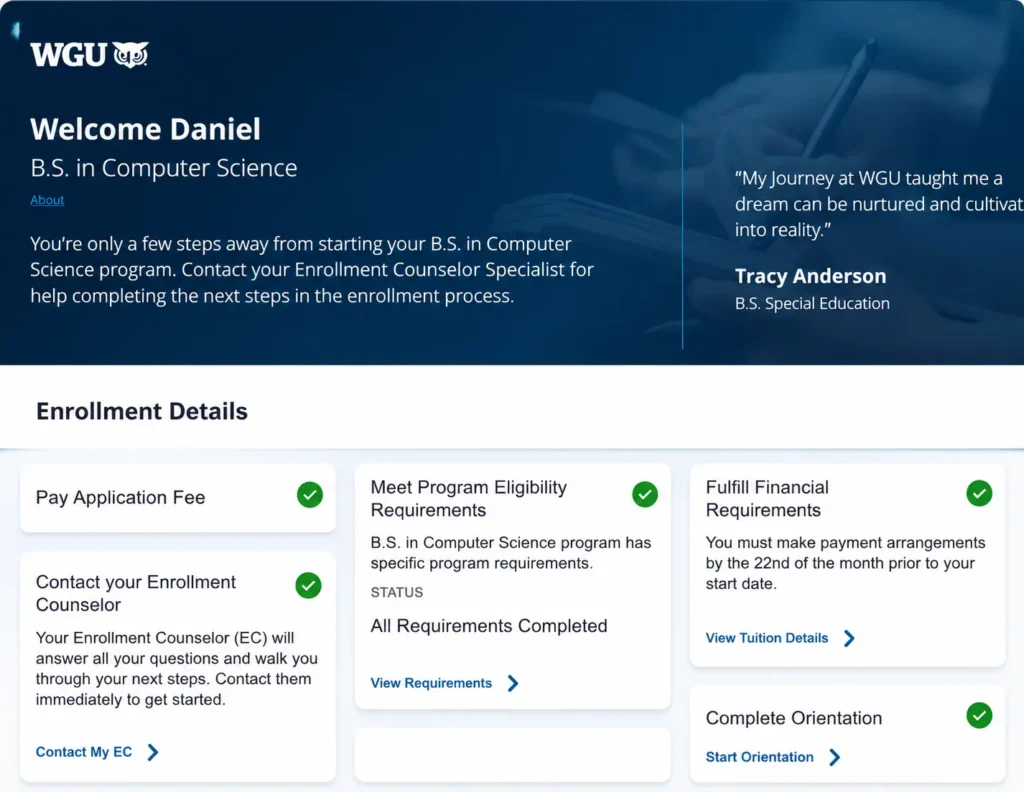
Complete WGU’s online application. You’ll provide your name, address, Social Security number, and details about your prior education, along with a roughly $65 application fee, per WGU’s official application page. There are no fixed application deadlines you can apply any day of the year.
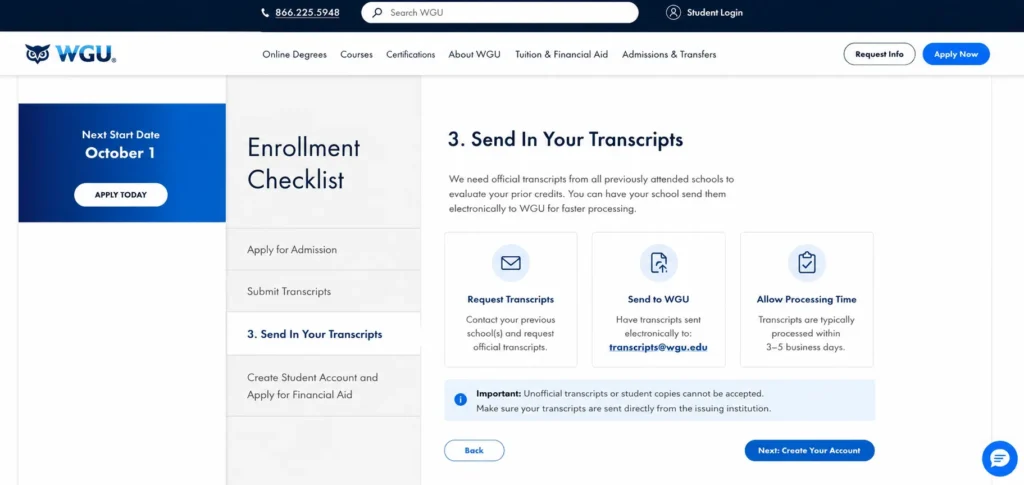
Step 3: Send In Your Transcripts
If you’ve completed prior college coursework, request official transcripts from every institution you attended for a transfer credit evaluation. If this is your first time in college, submit your official final high school transcript instead. (Full submission methods below.)
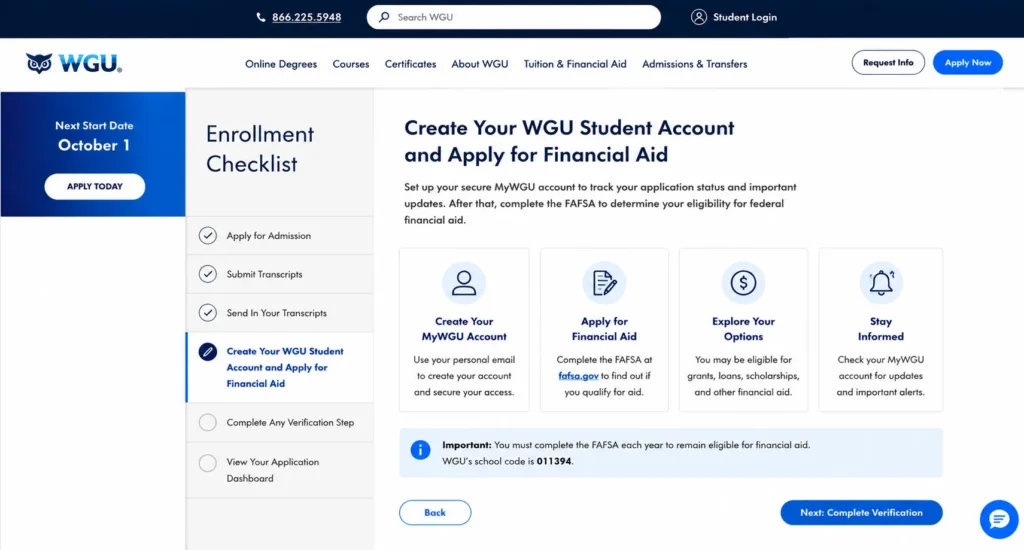
Step 4: Create Your WGU Student Account and Apply for Financial Aid
Once your application is in, set up your WGU student account. This is also when you complete the FAFSA if you’re pursuing federal aid, grants, or loans. Your Enrollment Counselor can walk you through how aid applies to WGU’s flat-rate tuition model.
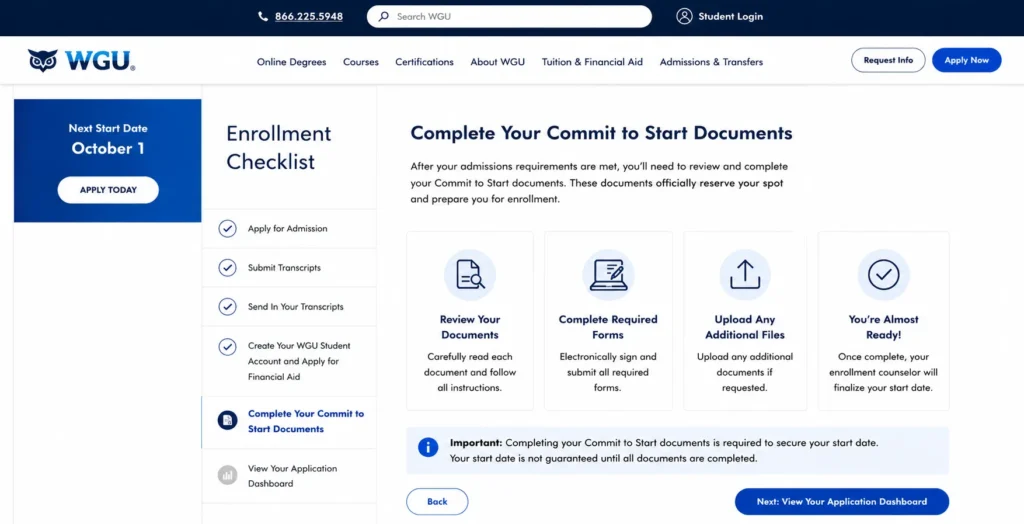
Step 5: Complete Your Commit to Start Documents
After an admission decision is made, you’ll finalize enrollment through the Commit to Start process either a self-guided web experience or a session with your Enrollment Counselor. This step officially locks in your program and your intended start date, and typically takes 20–30 minutes, according to WGU’s enrollment process page.
Step 6: Arrange Your Tuition Payment
Your first tuition payment is due by the 22nd of the month before your intended start, per WGU’s enrollment checklist. This can be out-of-pocket, through financial aid disbursement, or via employer tuition assistance if that applies to you.
Step 7: Complete Orientation
New students move into a short onboarding course (often referred to as WGU Foundations) that covers how competency-based, self-paced learning actually works, how to use the student portal, and how to plan your term with your assigned Program Mentor.
Step 8: Start Your WGU Degree Program
With orientation done, your first courses activate on your official start date the 1st of your chosen month. From here, your Program Mentor helps you set your pacing and sequence courses for the rest of your term.
Why WGU’s Enrollment Process Works Differently
WGU doesn’t run on the semester-deadline model most universities use. Instead, new terms start on the 1st of every month, and the whole enrollment sequence application, transcripts, financial aid, orientation is built around that rolling calendar. Because WGU is competency-based, you’re not paying per credit hour; you pay a flat tuition rate per six-month term and move as fast (or as deliberately) as you can demonstrate mastery.
Why this matters: since there’s no single “admissions season,” you can begin the process any day of the year. The only real deadlines are the ones tied to your chosen start month, not a university-wide cutoff.
How to Submit Your Transcripts
Transcripts are the single biggest bottleneck in WGU enrollment, so it’s worth getting this right the first time. WGU accepts transcripts two ways:
Electronic option: Most institutions can send transcripts directly to WGU through a secure electronic transcript service like Parchment or the National Student Clearinghouse. This is the faster route and is generally processed within a few business days.
Mail option: If your school doesn’t support electronic delivery, request a sealed, official paper transcript and have it mailed directly to WGU’s admissions office. Mailed transcripts take longer, so factor in extra time if you’re targeting a specific start month.
Why this matters: your admission decision isn’t finalized until WGU has received official transcripts a self-uploaded PDF or unofficial copy won’t count toward your evaluation.
International and Special Transcript Cases
A few situations come up often enough that WGU has specific guidance for each:
Financial Aid and Tuition Payment
WGU’s tuition is charged per six-month term, not per credit so the faster you complete competency units, the less you pay overall. During Step 4, your FAFSA submission determines your eligibility for:
Your first payment is due by the 22nd of the month prior to your start date, regardless of how your aid is structured so don’t wait on a financial aid decision to start planning payment.
A worked example: say you want to start on December 1. Working backward from the deadlines above, your application, transcripts, and Commit to Start documents all need to be finished by November 15, and your first tuition payment needs to clear by November 22. Compare that to a traditional semester school, where a December-cycle admissions deadline is often fixed months in advance (sometimes as early as August or September for a spring term) WGU’s rolling monthly intake compresses that planning window to about six weeks, which is faster but leaves less room for a slow transcript request to catch up.
Start Dates and Enrollment Deadlines
WGU’s monthly start model gives you far more flexibility than a traditional semester system, but it comes with its own fixed cutoffs, per WGU’s admissions requirements page:
| Milestone | Deadline |
| Application submission | No fixed deadline apply anytime |
| All enrollment steps (application through Commit to Start) | By the 15th of the month before your intended start |
| First tuition payment | By the 22nd of the month before your intended start |
| New term start | 1st of every month |
So, planning your start date backward from these two deadlines is the best method to avoid a delayed enrollment because missing the 15th almost always pushes your entire start date to the following month.
Tips for a Smooth Enrollment
FAQs
What is the WGU enrollment process?
It’s an 8-step sequence: explore programs, submit your application, send transcripts, create a student account and apply for financial aid, complete Commit to Start documents, arrange tuition payment, complete orientation, and start your program.
How long does WGU enrollment take?
There’s no fixed length it depends on how fast your transcripts process. Most applicants can move from application to Commit to Start within a few weeks if transcripts are submitted electronically.
How much is the WGU application fee?
Roughly $65, per WGU’s official application page.
Does WGU have application deadlines?
No fixed application deadline you can apply any day of the year. The deadlines that matter are tied to your chosen start month (the 15th for enrollment steps, the 22nd for tuition).
What transcripts does WGU require?
Official transcripts from every college you’ve attended, or your official final high school transcript if you haven’t attended college before.
How do I submit transcripts to WGU electronically?
Through a secure electronic transcript service like Parchment or the National Student Clearinghouse most institutions support this and it’s the faster option.
Can I mail my transcripts to WGU?
Yes, if your school doesn’t offer electronic delivery. Request a sealed, official paper transcript mailed directly to WGU’s admissions office, and build in extra time since mail is slower.
What if my prior college was outside the U.S.?
You’ll typically need a course-by-course foreign credential evaluation before WGU can assess transfer credit.
What if my prior college no longer exists?
WGU can often work with state archive records or accrediting body records instead contact your Enrollment Counselor for the specific process.
What if English isn’t my first language?
You may be asked for proof of English proficiency, depending on your prior education and country of residence.
What are WGU’s Commit to Start documents?
The final step that officially locks in your program and start date a self-guided web process or a session with your Enrollment Counselor, taking about 20–30 minutes.
When is WGU’s first tuition payment due?
By the 22nd of the month before your intended start date.
How often do new WGU terms start?
Every month, on the 1st.
What is WGU orientation?
A short onboarding course (often called WGU Foundations) covering how competency-based, self-paced learning works and how to use the student portal.
Does WGU accept transfer credit?
Yes prior college coursework is evaluated during the transcript submission step and can shorten your program.
What are WGU’s general admission requirements?
A high school diploma or GED (or prior college coursework), basic computer literacy and internet access, official transcripts, and a completed FAFSA if you want federal aid.
Do nursing programs have extra admission requirements at WGU?
Yes pre-licensure nursing programs require specific prerequisite coursework, proof of immunizations, and sometimes a background check or drug screening.
Can international students enroll at WGU?
Yes, though additional documentation like a credential evaluation or English proficiency proof may be requested depending on your background.
Who is my WGU Program Mentor?
A dedicated staff member assigned to you for the duration of your degree who helps set your pacing and sequence your courses.
What happens after I submit my WGU application?
Your transcripts are evaluated, an admission decision is made, and you move into the Commit to Start process to finalize your enrollment and start date.
Final Thoughts
The fastest path through WGU enrollment isn’t about rushing any single step it’s about running Steps 2 and 3 in parallel. Submit your application and request your transcripts on the same day, since transcript processing is almost always the slower of the two. From there, the 15th and 22nd deadlines do the rest of the planning for you: hit those, and your start date on the 1st is locked in without a scramble. I’d suggest treating your Enrollment Counselor as a resource from day one rather than a formality at the end they catch prerequisite and transfer-credit issues long before they become a delay.